Last updated on July 10, 2026·7 min read
10+ prediabetes statistics you need to know in 2026
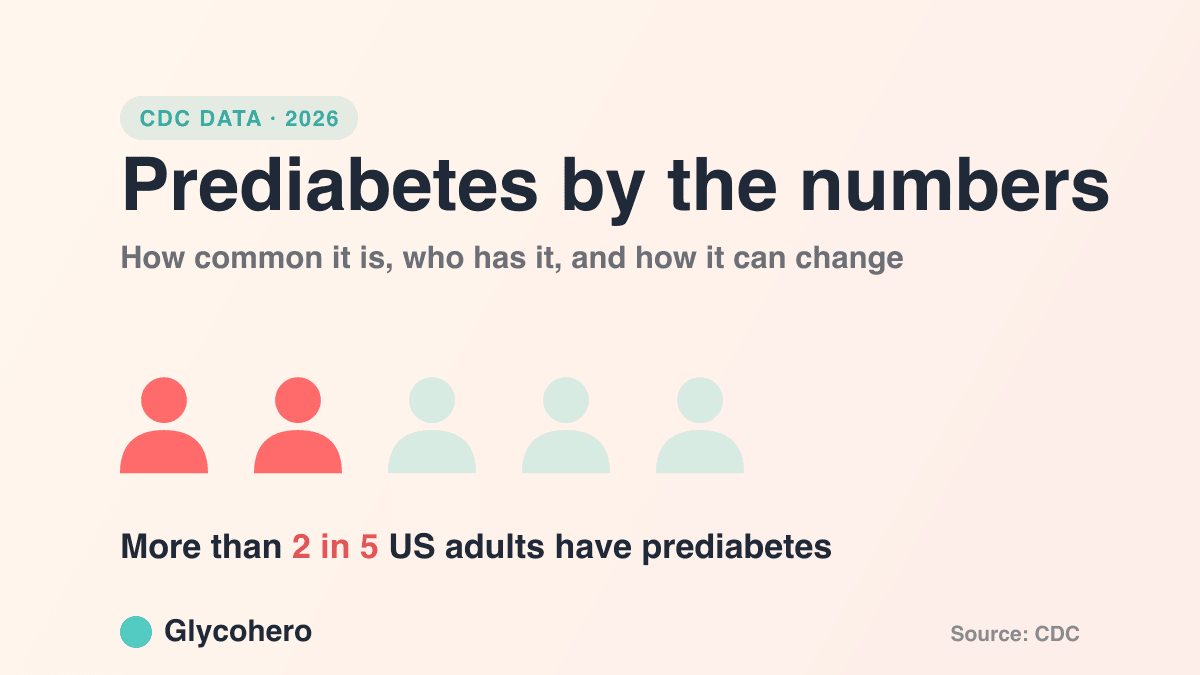
If you are looking for the headline number, here it is: about 115 million US adults have prediabetes, more than 2 in 5, and about 8 in 10 of them don’t know it. It is one of the most common health conditions in the country, and one of the most quietly overlooked.
Below are the key prediabetes statistics in plain numbers, with the primary sources behind each one. Prediabetes means blood sugar that is higher than normal but not yet high enough to be type 2 diabetes, and the figures show both how widespread it is and how much of it is reversible.
Prediabetes statistics at a glance
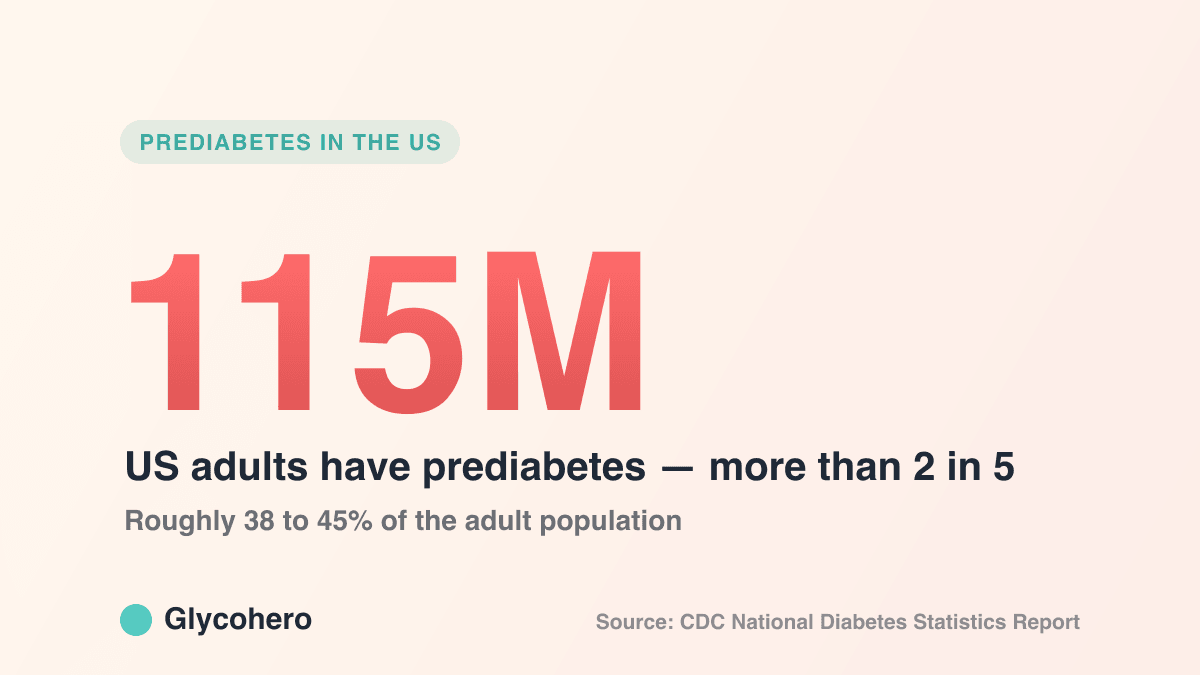
- About 115 million US adults have prediabetes, according to the CDC National Diabetes Statistics Report. That is more than 2 in 5 adults, roughly 38 to 45% of the adult population (CDC).
- About 8 in 10 adults with prediabetes do not know they have it (CDC).
- More than half of adults aged 65 and older have prediabetes: 31.3 million people, or 52.1% (CDC).
- About 1 in 5 adolescents aged 12 to 18 have prediabetes in a peer-reviewed JAMA Pediatrics analysis; a newer CDC estimate for ages 12 to 17 put the figure near 1 in 3 (JAMA Pediatrics, AP News).
- In the Diabetes Prevention Program placebo group, people with prediabetes developed type 2 diabetes at about 11 cases per 100 people each year (Diabetes Prevention Program Research Group).
- A structured lifestyle program can cut that risk by 58% (71% for people over 60), per the National Diabetes Prevention Program.
How many people have prediabetes?
More than 2 in 5 US adults, about 115 million people, have prediabetes. That is the figure in the most recent CDC National Diabetes Statistics Report, and it makes prediabetes far more common than diabetes itself, which affects about 40 million Americans, or about 12% of the US population.
You may also see the numbers 96 million or 97.6 million, often paired with “more than 1 in 3.” Those come from earlier editions of the same CDC report built on older survey years. The direction of travel is the same either way: a large and growing share of American adults are already in the prediabetes range.
Most people don’t know they have it
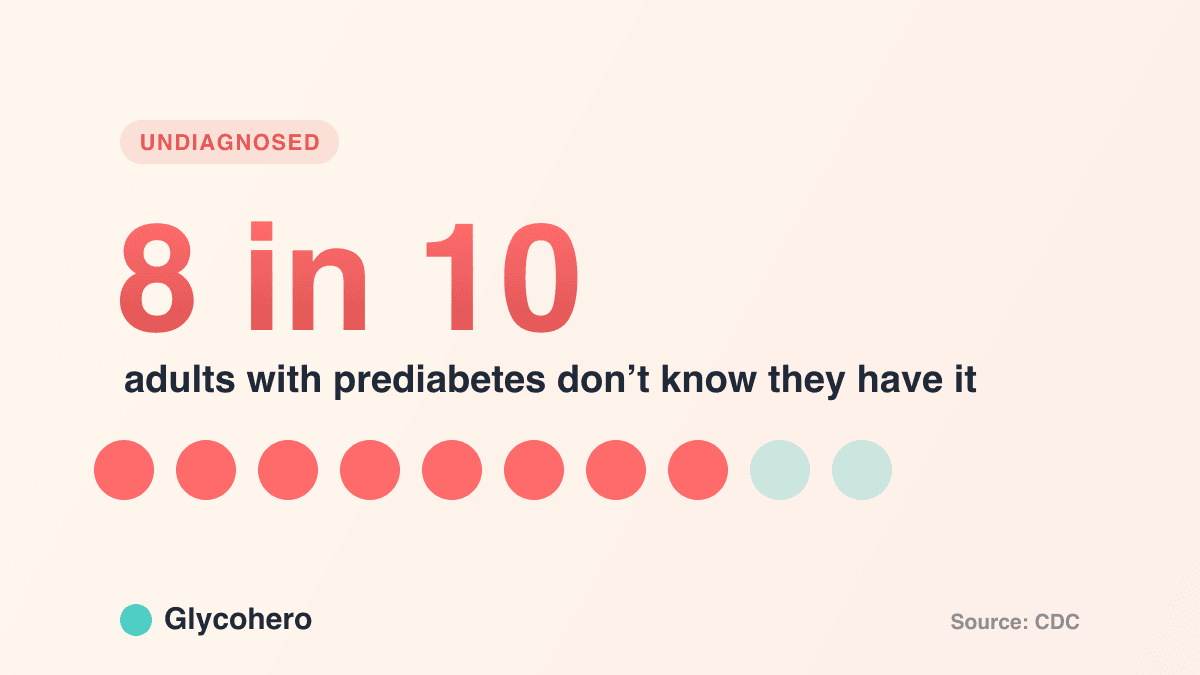
About 8 in 10 adults with prediabetes are unaware of it, according to the CDC. Put another way, only about 1 in 5 adults with prediabetes know they have it.
The reason is simple: prediabetes usually has no obvious symptoms. There is no dramatic reading on a meter, no clear warning sign, often nothing you would feel day to day. That is what makes the statistic striking. Tens of millions of people are walking around with elevated blood sugar and no idea, which is why prediabetes is often called a “silent” condition and why a simple blood test matters more than waiting for symptoms.
Prediabetes in older adults
Prediabetes becomes especially common later in life. The current CDC National Diabetes Statistics Report estimates that 31.3 million adults aged 65 and older have prediabetes, equal to 52.1% of that age group (CDC).
That older-adult number deserves a separate callout, but prediabetes is not only a condition of later life. The youth data below shows why prediabetes is also becoming a pediatric and young-adult concern.
Prediabetes in children and teens
This is the statistic that has changed the most. About 1 in 5 US adolescents aged 12 to 18 have prediabetes. That figure, 18%, comes from a peer-reviewed JAMA Pediatrics analysis of national survey data, which also found prediabetes in 24% of young adults aged 19 to 34, close to 1 in 4.
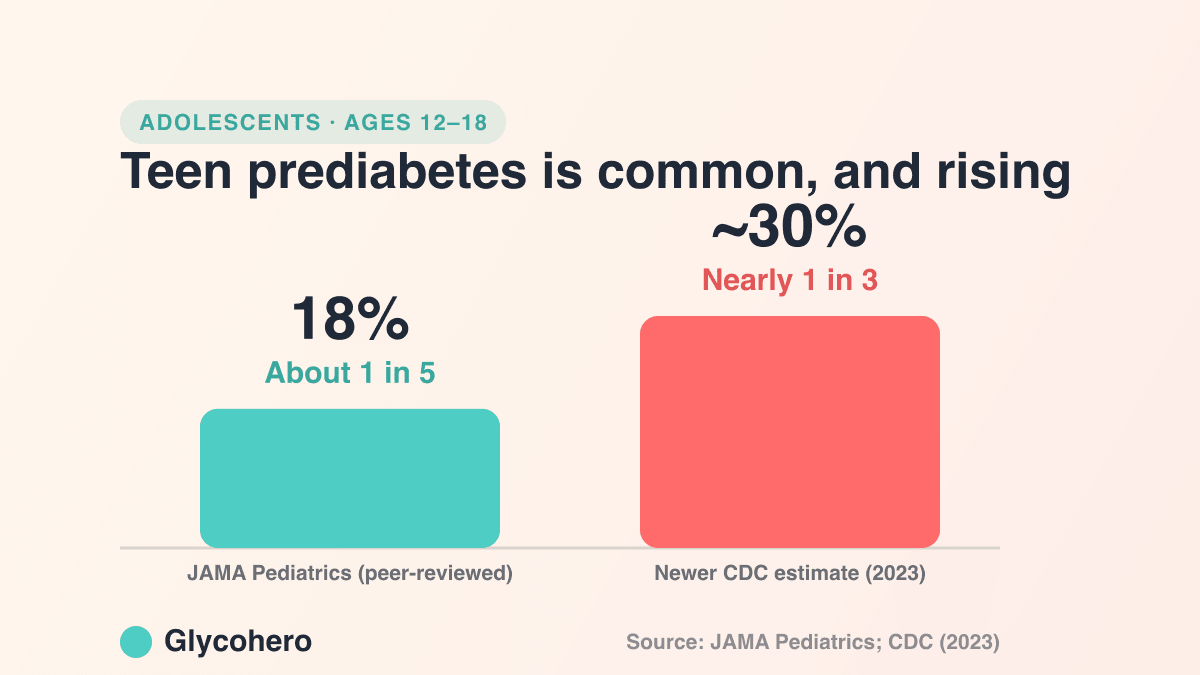
A newer CDC estimate for 2023 put prediabetes at nearly 1 in 3 adolescents aged 12 to 17, or about 8.4 million young people. That higher number used an updated method and came with limited public detail, so outside experts have urged caution. The honest summary is that adolescent prediabetes looks common either way: the peer-reviewed estimate is about 1 in 5, while the newer CDC estimate is close to 1 in 3.
How often prediabetes turns into type 2 diabetes
Prediabetes is a risk state, not a guarantee, but the odds without an intensive intervention are significant. In the landmark Diabetes Prevention Program, participants in the placebo group developed type 2 diabetes at a rate of 11 cases per 100 people each year, close to 3 in 10 over the roughly three-year study. That comparison group received standard advice rather than the intensive lifestyle program.
That is the “why it matters” number. Prediabetes is the last clear off-ramp before type 2 diabetes, and it is the point where change makes the biggest difference.
How long it takes to reverse prediabetes
Here is the more hopeful side of the data: prediabetes can be reversible, but there is no fixed timeline. Some people return blood sugar to a normal range within a few months to a year, while others need longer or need medication support. The timing depends on starting point, weight, medications, and consistency, but the effect of modest changes is large and well documented.
The landmark evidence is the Diabetes Prevention Program. The lifestyle group had goals of at least 7% weight loss (14 pounds for someone weighing 200) and at least 150 minutes of physical activity each week. That intervention cut the risk of developing type 2 diabetes by 58% compared with placebo. For people over 60, the reduction was 71%. At the 10-year follow-up, the lifestyle group still had a 34% lower diabetes rate than the placebo group.
The practical levers are familiar: steadier meals with fewer blood sugar spikes, more movement, and gradual weight loss. If you want a sense of which foods push blood sugar up fastest, our guide to foods that spike blood sugar and our glycemic index food list are good starting points.
What counts as prediabetes: the exact numbers
Prediabetes is defined by three tests, and any one of them in the ranges below puts you in the prediabetes category. The cutoffs below match the CDC diabetes testing ranges.
| Test | Normal | Prediabetes | Diabetes |
|---|---|---|---|
| A1C | Below 5.7% | 5.7% – 6.4% | 6.5% or above |
| Fasting glucose | Below 100 mg/dL (5.6 mmol/L) | 100 – 125 mg/dL (5.6 – 6.9 mmol/L) | 126 mg/dL (7.0 mmol/L) or above |
| 2-hour glucose (OGTT) | Below 140 mg/dL (7.8 mmol/L) | 140 – 199 mg/dL (7.8 – 11.0 mmol/L) | 200 mg/dL (11.1 mmol/L) or above |
A couple of things people often search for:
- An A1C of 5.4, 5.5, or 5.6% is still normal. Prediabetes starts at 5.7%. The closer you sit to that line, the more it is worth watching, but those readings are not yet prediabetes.
- A fasting reading of 100 to 125 mg/dL is the prediabetes band. Working between units? A reading in mg/dL divided by 18 gives you mmol/L, and our blood sugar converter does it instantly in either direction.
For where these numbers sit on the wider scale, including the levels that become an emergency, see what blood sugar level is dangerous.
Learn blood sugar through play
Numbers on a page are one thing; feeling how food and movement move your blood sugar is another. Glycohero turns it into a 2D platformer: grab quality carbs, dodge the danger foods that spike you into the high zone, and exercise to bring high readings back down into the healthy range. The values are calibrated to real-world numbers, so the intuition, the same intuition that helps keep prediabetes in check, transfers to real life.
Play the first level free in your browser, or get the full game on iOS.
A note on the numbers
Prediabetes figures shift as national surveys are updated and as definitions are refined, which is why you will sometimes see two different headline numbers for the same thing. We have used the most recent CDC estimates here and noted the earlier ones where they still circulate. This article is educational and is not a substitute for medical advice; a blood test from a health professional is the only way to know where your own numbers sit.
Reference
- https://www.cdc.gov/diabetes/php/data-research/index.html
- https://www.cdc.gov/diabetes/communication-resources/prediabetes-statistics.html
- https://www.cdc.gov/diabetes/diabetes-testing/index.html
- https://jamanetwork.com/journals/jamapediatrics/fullarticle/2755415
- https://apnews.com/article/prediabetes-cdc-adolescents-data-cf752de21856b2886450621d85d93370
- https://www.niddk.nih.gov/about-niddk/research-areas/diabetes/diabetes-prevention-program-dpp
- https://www.cdc.gov/diabetes-prevention/programs/index.html
- https://www.nejm.org/doi/full/10.1056/NEJMoa012512
Frequently asked questions
- What percentage of Americans have prediabetes?
- More than 2 in 5 US adults have prediabetes, roughly 38 to 45% of the adult population. In the most recent National Diabetes Statistics Report, the CDC puts the number at about 115 million adults. Earlier reports using different survey years cited about 96 to 98 million (more than 1 in 3), so you will see both figures quoted.
- How many people have prediabetes and don't know it?
- About 8 in 10 adults with prediabetes do not know they have it, according to the CDC. Put another way, only about 1 in 5 adults with prediabetes know they have it. Prediabetes usually has no clear symptoms, which is why so much of it goes undiagnosed.
- What proportion of adolescents have prediabetes in the US?
- About 1 in 5 US adolescents aged 12 to 18 have prediabetes, based on a peer-reviewed JAMA Pediatrics analysis that found a prevalence of 18%. A newer CDC estimate for ages 12 to 17 put the figure near 1 in 3 in 2023.
- How long does it take to reverse prediabetes?
- There is no fixed timeline. Some people return their blood sugar to a normal range within a few months to a year, while others need longer or need medication support. In the Diabetes Prevention Program, a lifestyle group goal of at least 7% weight loss and 150 minutes of activity a week cut the risk of type 2 diabetes by 58%.
- Is an A1C of 5.6 prediabetes?
- No. An A1C of 5.6% is still in the normal range. Prediabetes starts at 5.7% and runs up to 6.4%; an A1C of 6.5% or higher on repeat testing points to diabetes. So 5.4, 5.5, and 5.6% are all considered normal, though the closer you get to 5.7, the more it is worth watching.
- What blood sugar level is prediabetes?
- Prediabetes is a fasting blood sugar of 100 to 125 mg/dL (5.6 to 6.9 mmol/L), an A1C of 5.7 to 6.4%, or a 2-hour glucose of 140 to 199 mg/dL (7.8 to 11.0 mmol/L) on a tolerance test. Below those ranges is normal; above them is diabetes.
- Does prediabetes make you tired?
- It can, though prediabetes often causes no symptoms at all. Blood sugar that runs above the normal range can leave some people feeling tired or sluggish, especially after meals. Fatigue alone is not a reliable sign, which is one more reason prediabetes usually needs a blood test to catch.