Last updated on June 11, 2026·5 min read
Foods that spike blood sugar (and what to eat instead)
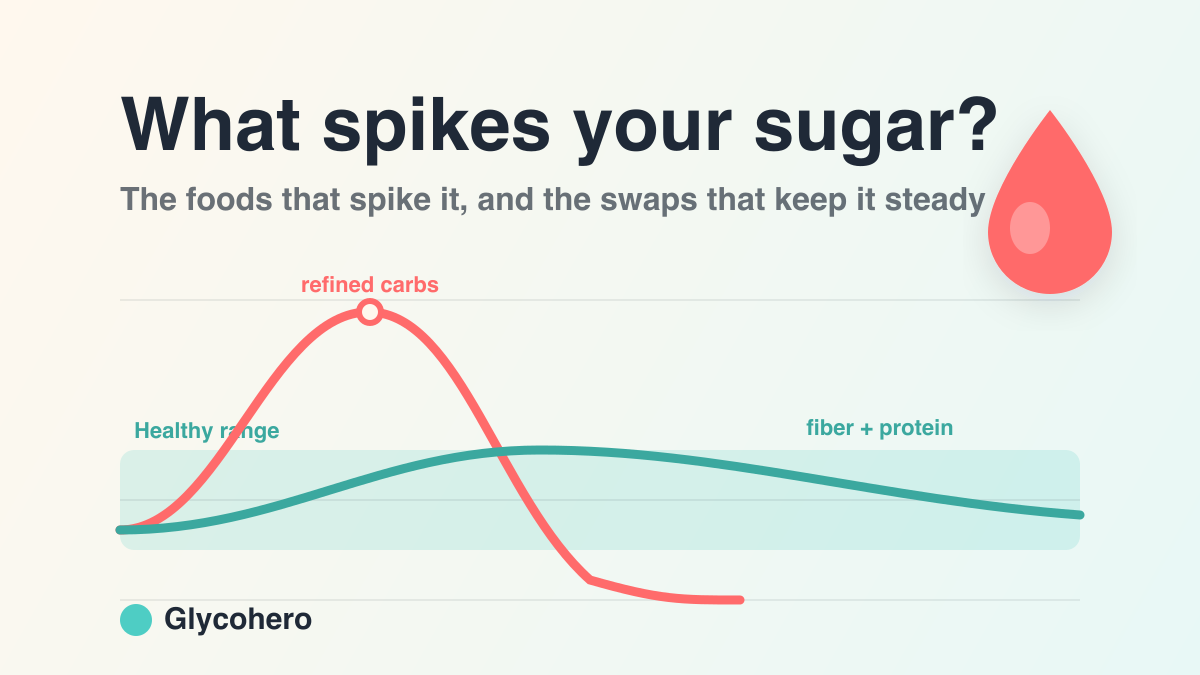
Every food made of carbohydrate raises your blood sugar to some degree. The question that actually matters is how fast and how high. A bowl of lentils and a can of soda contain similar carbs, but one produces a gentle ripple and the other a steep spike followed by a crash.
Here is what makes the difference, which everyday foods spike the hardest, and the simple swaps that keep your levels steady.
The short answer
The foods that spike blood sugar fastest are fast-digesting carbohydrates with little fiber, fat, or protein to slow them down. That means sugary drinks, white bread, white rice, breakfast cereal, pastries, sweets, and white potatoes. They sit high on the glycemic index, so the glucose in them hits your blood almost as quickly as pure sugar.
The good news: you rarely have to cut these foods entirely. Changing the type, the portion, or what you eat alongside them is usually enough to turn a spike into a gentle rise.
What actually makes a food spike your blood sugar
Four things decide how steep the rise will be:
- Glycemic index (speed). The glycemic index ranks carb foods from 0 to 100 by how fast they raise blood sugar. Low is 55 or below, high is 70 or above. White bread is roughly 75; lentils are about 30. However, note that glycemic index values are lab averages and your own response can differ. Treat the numbers as a guide for comparing foods, not a precise rule. See why you should not trust GI 100% for more.
- Fiber. Fiber slows digestion, so whole, fiber-rich carbs release glucose gradually. Stripping the fiber out (white flour, juice) removes the brake.
- Fat and protein. Eating carbs alongside fat or protein slows stomach emptying, so the same carbs spike less. Bread alone spikes; bread with eggs and avocado does not.
- Processing and ripeness. The more a food is broken down before it reaches you, the faster it digests. Finely milled flour, instant oats, and very ripe fruit all spike more than their whole, less-ripe versions.
Foods that spike blood sugar
These are the usual culprits, roughly from fastest to more moderate:
| Food | Why it spikes |
|---|---|
| Soda, juice, sweet drinks | Liquid sugar with zero fiber, absorbed almost instantly |
| White bread, bagels, white rice | Refined starch, high glycemic index, low fiber |
| Breakfast cereal, instant oatmeal | Processed grains, often with added sugar |
| Pastries, cookies, cake | Refined flour plus sugar plus little fiber |
| White potatoes (mashed, fries) | Starch that digests very quickly, especially mashed |
| Candy and sweets | Concentrated sugar |
For a fuller breakdown with approximate glycemic index values, see our glycemic index food list.
”Wait, does that food spike blood sugar?”
A few common foods get asked about constantly because the answer is not obvious.
- Oatmeal. Steel-cut and rolled oats are slow and gentle. Instant or flavored packets spike fast because the oats are pre-broken-down and usually sweetened.
- Bananas. A green banana sits around 30 on the glycemic index; a ripe, spotty one climbs to about 60 as its resistant starch turns to sugar. Eat them on the firmer side and pair with nut butter.
- Popcorn. Plain air-popped popcorn is a whole grain and only moderate, around 55 to 65. The trap is portion size and the butter-and-sugar versions.
- Sweet potatoes. Often called a free pass, but they still raise blood sugar. Boiled sweet potato is gentler than baked or mashed, where the heat makes the starch even easier to absorb.
- Watermelon. Its glycemic index is high (about 72), but a normal serving contains few carbs, so the real-world impact (its glycemic load) is small. Portion is everything here.
What to eat instead
You do not need a special diet, just gentler defaults. A few swaps that make a big difference:
- Soda or juice becomes water, sparkling water, or unsweetened tea
- White bread becomes dense whole-grain or sourdough
- White rice becomes brown rice, quinoa, or barley
- Mashed potato becomes boiled new potatoes, or beans and lentils
- Sugary cereal becomes rolled oats with nuts and berries
- A snack of crackers becomes Greek yogurt, cheese, nuts, or veggies and hummus
Naturally steady foods you can lean on: non-starchy vegetables, eggs, fish, chicken, nuts, seeds, avocado, plain Greek yogurt, and most berries.
How to blunt a spike from any meal
Even when you do eat fast carbs, you can soften the curve:
- Pair, do not strip. Add protein and fat to every carb. Toast with eggs, fruit with nuts.
- Eat carbs last. Starting a meal with vegetables and protein, then eating the starch, produces a smaller spike than eating the starch first.
- Walk after eating. Even 10 to 15 minutes lets your muscles pull glucose out of the blood.
- Mind the portion. Half the rice, a normal handful of popcorn, a firmer banana. Amount matters as much as type.
See it through play
Glycohero turns this whole idea into a 2D platformer. You grab quality carbs, dodge the danger foods that spike you, and exercise to bring high readings back into the healthy range of 3.9 to 7.8 mmol/L (70 to 140 mg/dL). Every food in the game is rated by its real glycemic impact, so you build an instinct for which foods spike and which keep you steady.
Play the first level free in your browser, or get the full game on iOS.
Reference
Frequently asked questions
- What foods spike blood sugar the most?
- Fast-digesting, low-fiber carbohydrates spike blood sugar the most: sugary drinks (soda, juice, sweet coffee), white bread and white rice, breakfast cereals, pastries and sweets, and white potatoes. These are high on the glycemic index and contain little fiber, fat, or protein to slow digestion, so glucose floods into the blood quickly.
- Does oatmeal spike blood sugar?
- It depends on the type. Steel-cut and old-fashioned rolled oats are higher in fiber and digest slowly, so they cause a gentle rise. Instant or flavored oatmeal is processed and often sweetened, so it spikes blood sugar much faster. Adding protein and fat, such as nuts, seeds, or Greek yogurt, flattens the curve further.
- Do bananas spike blood sugar?
- Bananas raise blood sugar, but ripeness matters a lot. A green, less ripe banana has a glycemic index around 30 because much of its starch is still resistant starch. A fully ripe, spotty banana climbs to about 60 as that starch turns to sugar.
- Does popcorn raise blood sugar?
- Plain, air-popped popcorn is a whole grain and raises blood sugar moderately, with a glycemic index around 55 to 65. Portion size is the main issue, since it is easy to eat a large volume. Movie-style popcorn loaded with sugar, butter, or caramel raises blood sugar much more.
- What can I eat that will not spike my blood sugar?
- Non-starchy vegetables, eggs, fish, poultry, nuts, seeds, plain Greek yogurt, cheese, avocado, and most berries cause little or no spike because they are low in fast carbs and high in protein, fat, or fiber. When you do eat carbs, choosing lower glycemic index options and pairing them with protein and fat keeps the rise gentle.