Last updated on June 24, 2026·5 min read
What blood sugar level is dangerous?
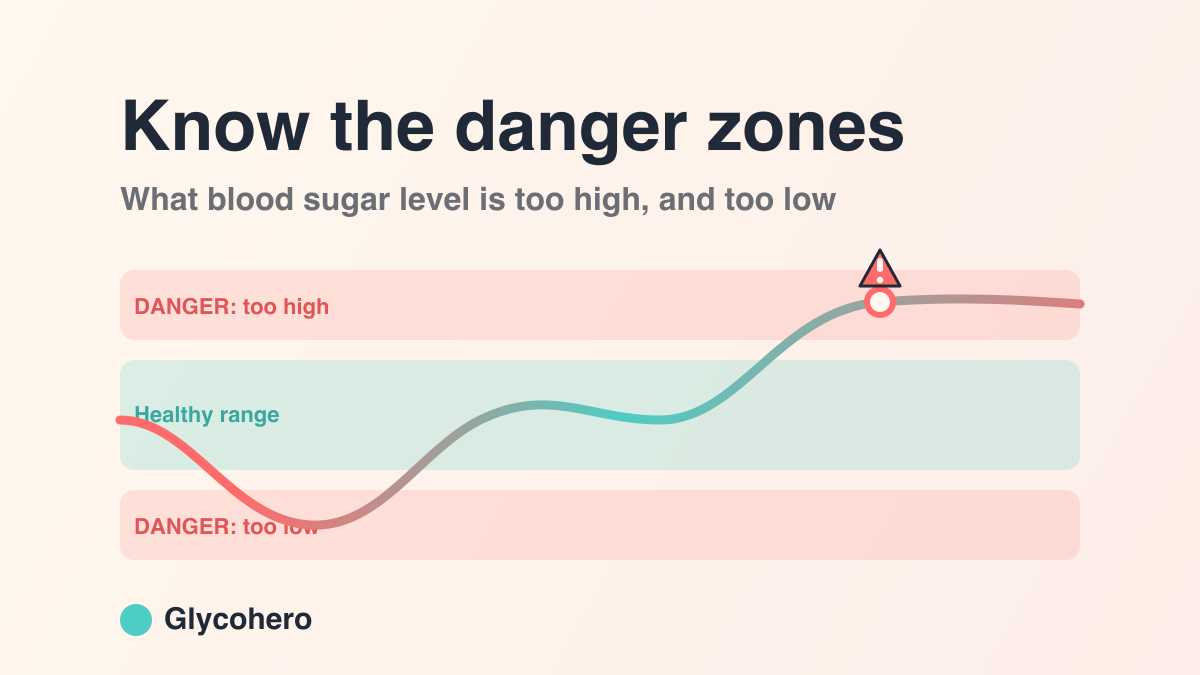
If you have just seen a high number on a meter and want to know whether it is dangerous, here is the short version: the danger zones are above roughly 13.9 mmol/L (250 mg/dL) and below 3.9 mmol/L (70 mg/dL), and a reading of 400 mg/dL (22.2 mmol/L) or higher should be treated as an emergency. Both ends of the scale are risky, not just the highs.
Below is a fuller picture of what each range means, in both units, plus the symptoms that turn a high number into an urgent one.
The ranges at a glance
These are general educational figures. Your personal targets may differ, so treat them as a map, not medical advice.
| Reading (mmol/L) | Reading (mg/dL) | What it means |
|---|---|---|
| Below 3.0 | Below 54 | Severe low, an emergency |
| 3.0 to 3.9 | 54 to 70 | Low (hypoglycemia), treat now |
| 3.9 to 7.8 | 70 to 140 | Normal range (2 hours after eating) |
| 7.8 to 10.0 | 140 to 180 | Elevated, common after meals |
| 10.0 to 13.9 | 180 to 250 | High (hyperglycemia), take action |
| 13.9 to 22.2 | 250 to 400 | Dangerous, check ketones and call your provider |
| Above 22.2 | Above 400 | Emergency, seek urgent care |
Working between units? A reading in mg/dL divided by 18 gives you mmol/L (so 400 ÷ 18 = 22.2). Our blood sugar converter does it instantly in either direction.
Dangerously high blood sugar
High blood sugar (hyperglycemia) becomes dangerous in stages, not all at once.
- Above 10.0 mmol/L (180 mg/dL): your kidneys start spilling glucose into urine, which causes thirst and frequent urination. Not an emergency, but a signal to act.
- Above 13.9 mmol/L (250 mg/dL): this is the warning level. Your body may start breaking down fat for fuel, producing ketones. A buildup of ketones can lead to diabetic ketoacidosis (DKA), a serious condition. If you can test for ketones, this is the point to do it.
- Above 22.2 mmol/L (400 mg/dL): treat this as an emergency, especially with symptoms. Extremely high blood sugar can progress to DKA or, particularly in type 2 diabetes, a hyperosmolar hyperglycemic state (HHS) driven by severe dehydration. Both can be life-threatening.
Call for help right away if a high reading comes with any of these:
- Nausea or vomiting
- Deep, rapid breathing
- Fruity-smelling breath
- Confusion or drowsiness
- Severe stomach pain
- Inability to keep fluids down
Those are signs of DKA or HHS, and they need medical care now, not later.
Dangerously low blood sugar
It is easy to fixate on highs, but lows can be more immediately dangerous because they come on fast and starve the brain of fuel.
- Below 3.9 mmol/L (70 mg/dL): hypoglycemia. Treat with fast-acting carbs, for example glucose tablets or juice, then recheck.
- Below 3.0 mmol/L (54 mg/dL): a severe low. This can cause confusion, slurred speech, seizures, or loss of consciousness, and is a medical emergency.
Lows are especially a risk for people taking insulin or sulfonylureas, and they can strike overnight. This is one reason alcohol can be risky: it can trigger a delayed low hours after drinking.
Why “how high before death” has no single answer
People often search for an exact fatal number, but there is not one. What turns a high reading dangerous is not just the value, it is how long it stays high, whether ketones and dehydration set in, and the person’s overall health. Two people at the same number can be in very different danger.
So the useful rule is not a threshold to memorize but a habit: very high readings, especially above 22.2 mmol/L (400 mg/dL) or alongside the warning symptoms above, mean it is time to get help, not to wait and watch.
The goal is steady, not just low
Because both ends are dangerous, the target is not the lowest possible number, it is a steady one inside the healthy band. In Glycohero we treat 3.9 to 7.8 mmol/L (70 to 140 mg/dL) as the safe zone: drift above it and you head toward the high-sugar dangers, drop below and you hit the lows. Staying centered is the whole game, on screen and in life.
If a high number left you feeling wiped out, that is no coincidence; here is why high blood sugar makes you tired.
A note on context
A single high or low reading is not automatically an emergency. Meter errors, a recent meal, stress, and illness all move the number. What matters is the size of the reading, the symptoms with it, and the trend over time. Use the ranges here to know when a number deserves attention, and when it deserves a phone call. This article is educational and is not a substitute for medical advice.
Feel the danger zones through play
Knowing the numbers is one thing; feeling how fast you can slide into a danger zone is another. Glycohero turns it into a 2D platformer: grab quality carbs, dodge the danger foods that spike you toward the high zone, and exercise to bring high readings back down into the healthy range before they tip into the red. The numbers are calibrated to real-world values, so the intuition transfers to real life.
Play the first level free in your browser, or get the full game on iOS.
Reference
Frequently asked questions
- What blood sugar level is dangerous?
- Both extremes are dangerous. On the high side, a reading above 13.9 mmol/L (250 mg/dL) is a warning level that can lead to diabetic ketoacidosis, and above 22.2 mmol/L (400 mg/dL) is a medical emergency. On the low side, below 3.9 mmol/L (70 mg/dL) is hypoglycemia, and below 3.0 mmol/L (54 mg/dL) is a severe low that needs immediate treatment. The healthy target range sits between roughly 3.9 and 7.8 mmol/L (70 to 140 mg/dL).
- Is a blood sugar of 400 dangerous?
- Yes. A blood sugar of 400 mg/dL (22.2 mmol/L) is dangerously high and should be treated as an emergency, especially with symptoms like nausea, vomiting, deep or rapid breathing, confusion, or fruity-smelling breath. These can signal diabetic ketoacidosis. Contact a healthcare provider or seek urgent care; do not wait to see if it comes down on its own.
- How high can blood sugar go before death?
- There is no single fatal number, because outcome depends on how long the level stays high, whether ketones or severe dehydration develop, and the person's overall health. Untreated, extreme highs can cause diabetic ketoacidosis or a hyperosmolar hyperglycemic state, both of which can be life-threatening. The takeaway is not a threshold to fear but a rule to follow: very high readings, particularly above 22.2 mmol/L (400 mg/dL) or with warning symptoms, are a medical emergency that needs prompt care.
- What is a dangerously low blood sugar level?
- Below 3.9 mmol/L (70 mg/dL) is low (hypoglycemia) and should be treated with fast-acting carbs. Below 3.0 mmol/L (54 mg/dL) is a severe low that can cause confusion, seizures, or loss of consciousness and is a medical emergency. Lows can be just as dangerous as highs and tend to come on much faster.
- Is 300 blood sugar dangerous?
- A reading of 300 mg/dL (16.7 mmol/L) is very high and warrants action. It is above the level where ketones can start to build, so it is worth checking for ketones if you can, watching for symptoms, and contacting a healthcare provider, particularly if it stays there or keeps climbing.
- What is a normal blood sugar level?
- A healthy range is roughly 3.9 to 7.8 mmol/L (70 to 140 mg/dL), lower when fasting and higher for a short time after meals. Fasting readings under 5.6 mmol/L (100 mg/dL) are considered normal, 5.6 to 6.9 mmol/L (100 to 125 mg/dL) suggests prediabetes, and 7.0 mmol/L (126 mg/dL) or above on repeat testing points to diabetes.